
AI agency, consultant, or freelancer: which to choose?
It depends on how much work there is and who will be responsible. A freelancer is good for a well-defined task; a consultant for deciding what to do; an agency when the project needs several skills at the same time.
| Criterion | Freelancer | Consultant | Agency |
|---|---|---|---|
| Good for | One defined task, such as building a flow | Understanding where AI pays off and where to start | One project with several pieces of work together |
| Advantage | Flexible and usually cheaper | A view of the whole business | Team, processes, and continuity |
| Risk | Depends on one person | Can stop at the plan | Higher fixed costs and work passed on to third parties |
| Ask | Who replaces them if they become unavailable? | Do they build, or only advise? | Who actually does the work? |
This table is our own assessment, with no fixed rule: there are excellent freelancers and weak agencies, and the reverse. The difference between a consultant and an agency is explained in AI consulting for small and mid-sized businesses (SMBs).
Which questions should you ask before hiring an AI agency?
Ask for what is put in writing: what they will build, how much everything costs, who owns the result at the end, where the data is kept, and how success is measured.
Eight questions you can use as they are:
- What exactly will they build, and what is left out?
- Who does the work, and who is responsible after it is delivered?
- Is the price fixed or hourly? What costs come after that, such as tools, the AI model, and the channel?
- Do the accounts, workflows, and files stay in my company's name?
- Where is my customers' data kept, and how do you comply with GDPR?
- What happens when the AI makes a mistake, and who approves what is sensitive?
- How do you measure results, without promising a position or a number?
- Does the agency itself already use this in its own business? Can you show it?
A good agency answers directly and in writing. If the answer is vague, you already have your answer.
Which warning signs should you watch for?
The most common are a promise of guaranteed results, no price or scope in writing, and a refusal to explain how what they sell works.
- Promises first place on Google or ChatGPT. Nobody controls what those tools show.
- Does not write down what it will do or what it will cost before starting.
- Sells "AI for everything" without starting from a concrete process in your company.
- Keeps your accounts, access, or files in its own name.
- Lets the AI send messages to customers with no limits and no approval.
- Asks for sensitive data before a signed agreement is in place.
What do GDPR and the AI Act say about hiring an AI agency?
If the agency handles your customers' personal data, GDPR requires a written agreement on that processing. The AI Act provides that people who talk to an AI are told so, unless it is obvious.
The AI Act is Regulation (EU) 2024/1689. Article 50 covers transparency: people must be told that they are interacting with an AI system, except when this is obvious to a reasonably attentive person (source: Article 50 of the AI Act, accessed November 15, 2026). Ask the agency how it complies with this for a chatbot or an agent that talks to your customers. This is not legal advice: for your case, talk to a lawyer.
When do you not need an AI agency?
When the problem can be solved with a tool you already have, or when the process is rare and the time saved does not pay for the work.
A simple flow between two apps can often be set up on your own, with Zapier, Make, or n8n.
If it doesn't pay to hire us, we'll tell you. To understand what it costs to put AI to work, see how much an AI agent costs. For an idea of what an agent is, see what are AI agents.
How does Marrow4 answer these questions?
With what Rui Navarro does in his own businesses, which he runs with AI agents and his own software, Rui OS.
See how in running a business with AI agents. The price of each project goes in a written proposal, fixed before work starts, and the 15-minute call is free.
See also what we do in AI agents for businesses and in AI automation for SMBs.
About the author
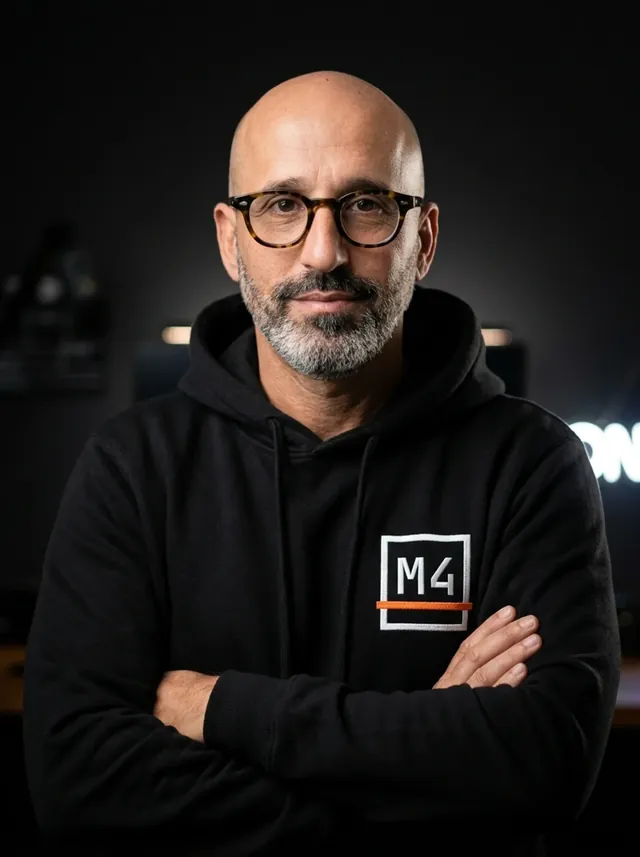
Rui Navarro is the founder of Marrow4. He has worked in digital marketing for more than 20 years, has more than 200,000 followers on social media, and created Rui OS, the software he uses in his own businesses. Who is Rui Navarro